
The curvaceous lines favoured by master craftsmen like Vladirmir Kagan and Pierre Paulin have inspired contemporary designers to create pieces with organic forms. In this article we reveal manufacturing secrets, and discuss which upholsteries will accentuate curves in all the right places.
Blog

TAIGA BY CASAMANCE

FONTAINE BY ZEPEL

ETHOS LOUNGE, E9 DESIGN UPHOLSTERED IN FONTAINE BY ZEPEL
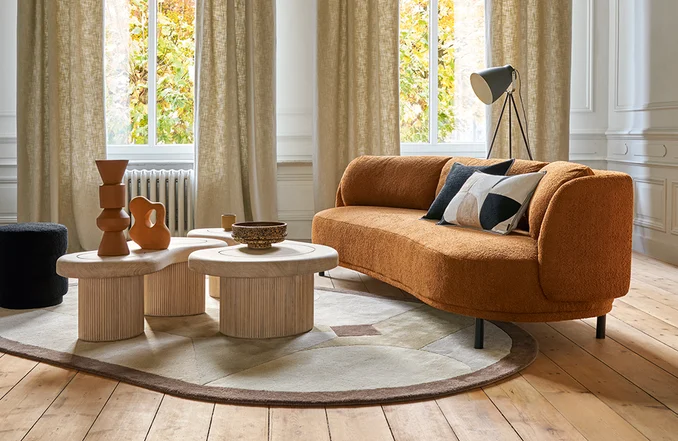
NEPAL BY CASAMANCE

ETHOS LOUNGE, E9 DESIGN UPHOLSTERED IN FONTAINE BY ZEPEL
Upholstering Organic Lines
Sculptural pieces of curved furniture bring softness to the straight lines of our homes
AUTHENTIC CURVATURE
AUTHENTIC CURVATURE
While an authentic curve is rare in a piece of furniture, Danish Modernist Arne Jacobsen's Egg Chair is a great example. Initially made in Jacobsen's garage, the curves of the chair are formed in a way that create minimal seams, a finish additionally achieved by being upholstered in felted wool or leather - a material both highly flexible and durable. Felted wool and leather are capable of conforming to the contours of the chair without the need for noticeable anchor points to secure them in position. Unfortunately, vinyl is incapable of conforming to surfaces in the same way that natural leather can, making it an inappropriate option.

Egg Chair by Arne Jacobsen | Images sourced from Pinterest
Wool-blend textiles such as Benu Remix by Christian Fischbacher, and Arthurs Seat by Casamance, present an ideal companion to organic forms in a range of residential and commercial interior designs in both modern and classic applications. Furthermore, the wool component ensures the material's flexibility.
To achieve a curved shape in two directions, like the backrest of the Kashmir Stool designed by Simon James for Resident, a fabric must possess a four-way stretch capability. Only leather and felted wool can stretch in four directions; if you wish to utilize other types of fabrics, such as weaves or cut pile velvets, seams will be necessary to achieve the desired effect.
Contemporary fabrics are often made with a backing to improve the upholstery's capacity to glide over the foam without causing damage to either the fabric or the foam during use. While this backing prolongs the lifespan of both the fabric and foam, it makes accomplishing four-way stretch virtually impossible.

A TRICK OF THE EYE
A TRICK OF THE EYE
Most curved furniture is skilfully constructed in panels, with seams connecting bias-cut fabric pieces to create the impression of a curve. This kind of craftsmanship doesn't demand any particular fabric; the choice is entirely up to you, however, it's essential to consider where the seams will be located and how the pattern or stripes will align. Textured fabrics, like Fontaine or Cheviot by Zepel, and directional pile fabrics, such as Zepel’s Lux Velvet, are excellent choices to upholster a sculptural furniture piece as they enable the structure of the design to be the focal point.
The Indigo Armchair by Jardan and the Glenaire Low Back Swivel Chair by Cosh Living are widely favoured in both residential and commercial settings, and feature either two or four seams on their backrests. By cutting the fabric on the bias and incorporating seams into the design, the material can conform to the chair's shape without forming wrinkles or ripples along the curve.

Fabric elasticity also supports the form of furniture. This specifically refers to a fibre’s ability to bounce back to its original shape, length, and size immediately after the stress is removed. Unlike natural fibres, synthetic fibres typically have limited or no stretchability. A slight stretch on the bias is crucial for organic furniture pieces, as it enables the fabric to remain taut at the back of the chair and hug the curve without puckering. We always recommended checking the fabric's elasticity with the manufacturer to verify that it's suitable for the type of furniture you have chosen to upholster.
In 2009 Christian Fischbacher introduced their first offering of luxury fabrics composed of recycled yarn in the collection, Benu Recycled. This milestone was fostered by Creative Director Camilla Fischbacher, who has been consistently working towards incorporating sustainable practices and innov...
