
A brief textile history
Blog

Vanoise by Casamance

Arpege by Casamance

Pacte by Casamance
Checks, Plaids, and Tartans
Plaids and checks have long been woven into textile history, each with distinct origins and intricate designs. This article unravels their meanings, the differences between tartan and Scottish tartan, and their presence in our fabric collection.

Plaids vs Checks
Plaids vs Checks
A plaid is a fabric, either printed or woven, characterized by intersecting vertical and horizontal stripes in different widths and colours. Unlike checks, plaids have more complex, often asymmetrical or irregular patterns.
The word "plaid" comes from the Gaelic language, originally describing a large woollen blanket worn in traditional Highland attire. Over time its meaning shifted, particularly in North America, where it now refers to any checkered or tartan-patterned fabric.
Checks are evenly spaced patterns of intersecting stripes that create symmetrical squares. Found in various styles globally, they are often made from light fabrics like cotton or linen, unlike the heavier wool used for plaids and tartans.
Scottish Tartans
Scottish Tartans
All tartans are plaids, but not every plaid is a tartan.
The Scottish Register of Tartans defines tartan as a woven design of two or more-coloured stripes crossing vertically and horizontally to create a repeating checked pattern, known as the tartan's 'sett'.
In tartan weaving, the sequence of warp colours and widths is mirrored in the weft, creating solid colour blocks where matching threads intersect. When different colours cross, they form a ‘half-tone’ effect. Traditionally, tartans use a 2/2 staggered twill weave, resulting in a signature diagonal pattern, especially visible in half-tone areas.
The earliest Scottish tartan, dating to 230 AD, was discovered in the Falkirk Hoard with Roman coins. Communities traditionally obtained tartans from local weavers, colouring them with natural dyes—gipsywort for green, heather for yellow or orange, and blaeberries for purple. Wealthier buyers could opt for rare, imported dyes like cochineal and indigo for greater variety and distinction.
Originally, tartans represented local districts. The concept of clan-specific patterns emerged after the 1745 Battle of Culloden, when Britain's Disarming Act banned tartan clothing for 36 years. Today, patterns are officially documented in the Scottish Register, preserving these important cultural textiles.
TARTAN (PLAID)
TARTAN (PLAID)
Plaid –
Plaids differ technically from tartans by having varied colours or sequences in the warp and weft, rather than the identical arrangement seen in tartans. However, in practice, the textile industry often uses the terms ‘plaid’ and ‘tartan’ interchangeably.


BUFFALO
BUFFALO
Plaid –
Buffalo plaid, often mistaken for an oversized check, features bold two-tone squares created by intersecting stripes. Woven in a 2/2 twill, it has a distinct, high-contrast look.
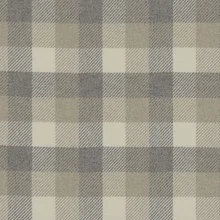

WINDOWPANE
WINDOWPANE
Check –
Also called French windowpane or brunswick check, this pattern features thin, widely spaced coloured lines forming a grid on a solid background, resembling windowpanes.


TATTERSALL
TATTERSALL
Check –
Tattersall is defined by narrow, evenly spaced coloured lines set on a white base. Unlike windowpane, tattersall has two overlapping grids, producing a layered visual effect.
CHECKERBOARD
CHECKERBOARD
Check –
Checkerboard is a simple, bold pattern featuring two contrasting colours arranged in a grid, resembling a chessboard.



HOUNDSTOOTH
HOUNDSTOOTH
Check –
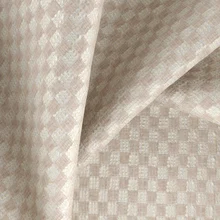
Named for its jagged, tooth-like pattern, houndstooth is formed by the strategic arrangement of colours in the warp and weft. Unlike simpler checks woven in plain weave, it is typically crafted using a twill weave for added texture and depth.


The curvaceous lines favoured by master craftsmen like Vladirmir Kagan and Pierre Paulin have inspired contemporary designers to create pieces with organic forms. In this article we reveal manufacturing secrets, and discuss which upholsteries will accentuate curves in all the right places.
